Lab news
Thesis defence Giridhar Sunil successfully defended his Master's thesis

Congratulations to Giridhar Sunil for successfully passing his Master's degree!
Thesis title: Thermodynamic connectivity reveals functional specialization and multiplex organization of extrasynaptic signaling
Preprint New preprint on weight geometry and functional memory
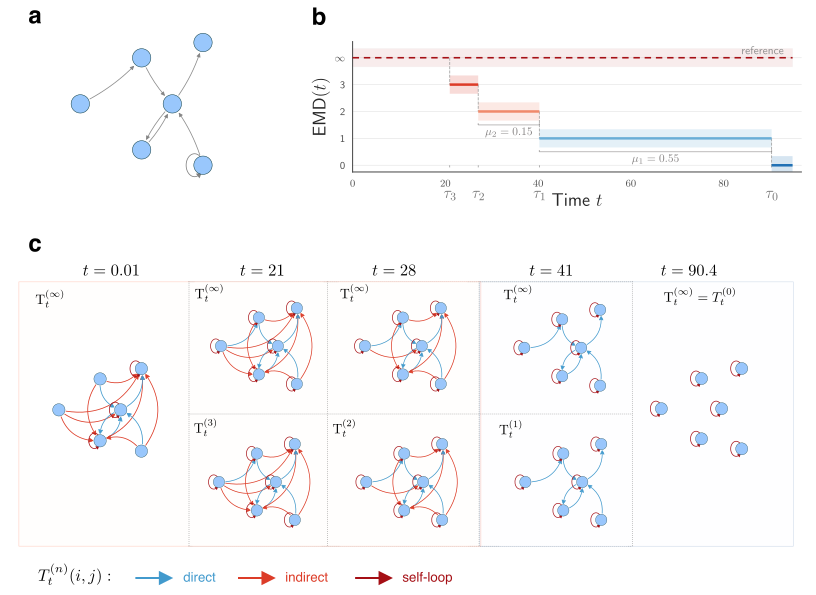
Weight geometry governs functional memory in complex systems
By Elkaïoum M. Moutuou and Habib Benali
Description
This preprint studies how interaction strengths shape functional memory in complex networks. Across 34 empirical systems, real weight patterns preserve deeper memory than randomized weights on the same topology, while the resulting memory profiles fall into four recurring dynamical organizations.
Abstract
Complex systems, from gene regulatory networks to neural circuits and ecological food webs, exhibit rich functional behaviour that topology alone does not capture. Yet functional complexity remains difficult to quantify independently of structural organisation.
Here we introduce a thermodynamic framework in which functional complexity is characterised through the hierarchical organisation of functional memory, quantifying how the influence of past interactions is distributed and progressively compressed across scales.
Across thirty-four empirical networks spanning biological, ecological, social, technological, and biophysical systems and several orders of magnitude in size and density, real interaction strengths organise functional memory at greater hierarchical depth than random weight assignment on the same topology in every domain studied. The framework further reveals that functional memory occupies a remarkably low-dimensional space, collapsing onto four recurrent dynamical organisations.
Comparisons with null models that selectively perturb weighted transport geometry, mesoscale wiring, and directionality show that these structural ingredients play distinct roles: weighted transport geometry systematically governs memory depth, whereas mesoscale wiring organises memory across scales and directionality modulates the response of the cascade to structural perturbation.
The same comparisons provide an operational criterion for determining whether network weights encode functionally meaningful structure beyond topology. These results establish weighted transport geometry as a primary organiser of functional memory and provide a quantitative framework for studying functional complexity in directed weighted networks.
Preprint New preprint on thermodynamic connectivity and extrasynaptic signaling
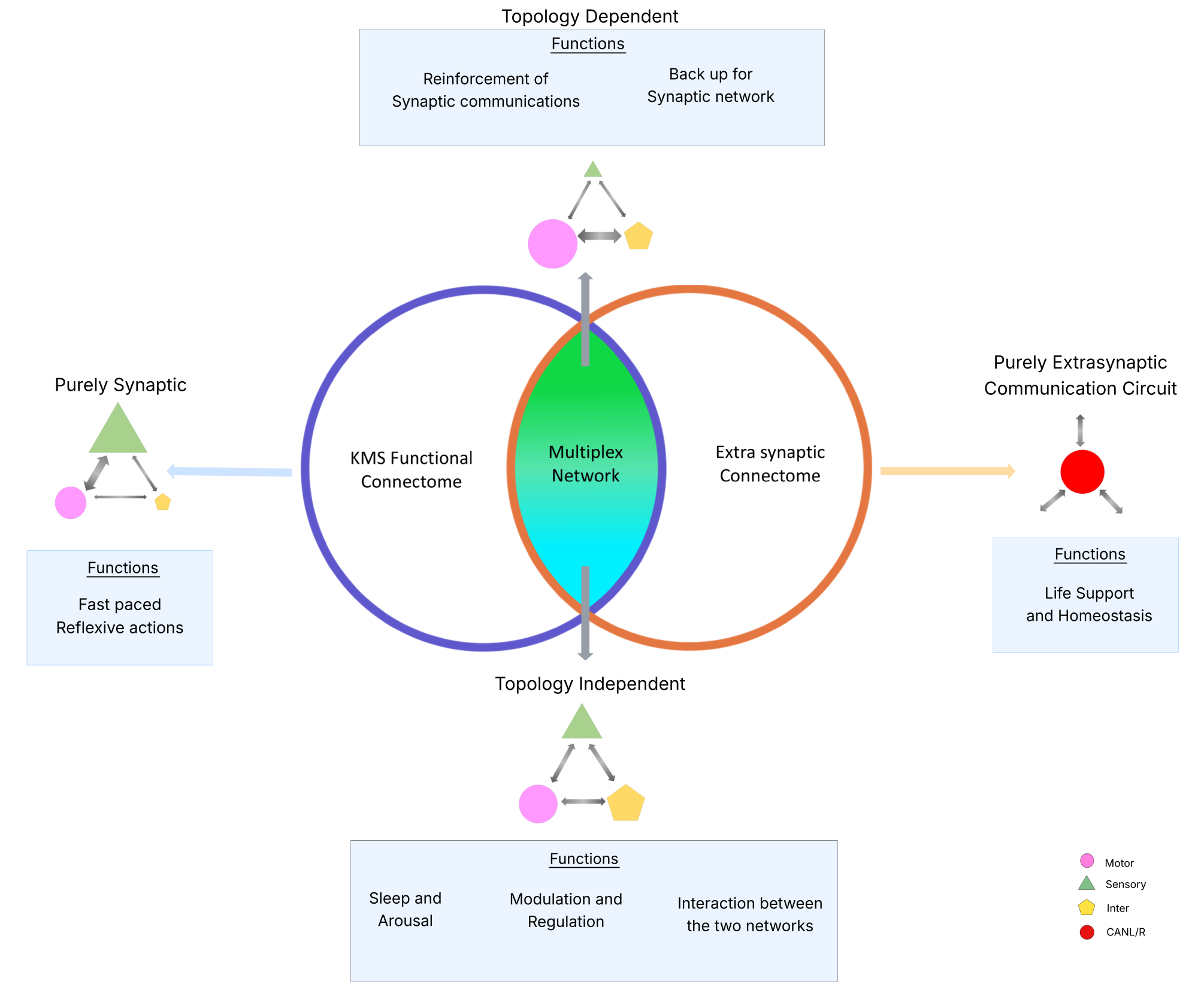
Thermodynamic connectivity reveals functional specialization and multiplex organization of extrasynaptic signaling
By Giridhar Sunil, Habib Benali, and Elkaïoum M. Moutuou
Description
This preprint examines how synaptic and extrasynaptic signaling divide functional roles in the C. elegans nervous system. It identifies four communication regimes associated with motor-circuit reinforcement, global modulation, survival and homeostasis, and rapid sensorimotor processing.
Abstract
Neural communication operates on both fast synaptic transmission and slower, diffusive extrasynaptic signaling, yet how these two modes jointly organize brain function remains unclear. Here, using the complete synaptic and neuropeptidergic connectomes of Caenorhabditis elegans, we develop a unified multiplex framework linking anatomical wiring to functional communication.
We infer structure-derived functional connectivity from the synaptic connectome using equilibrium principles from statistical physics, yielding a probabilistic map of information flow across all synaptic pathways, and compare this functional layer directly with the extrasynaptic connectome.
This reveals a principled functional specialization across four communication regimes: (i) a topology-dependent layer that reinforces and stabilizes synaptic motor circuits, (ii) a topology-resilient modulatory layer supporting global regulation and behavioral state control, (iii) a purely extrasynaptic network sustaining survival and homeostasis, and (iv) a purely synaptic regime mediating rapid, low-latency sensorimotor processing.
Together, these findings reveal that synaptic and extrasynaptic signaling form complementary architectures optimized for speed, modulation, robustness, and survival, and provide a general strategy for integrating structural and modulatory connectomes to understand how distinct communication modes cooperate to sustain coherent brain function.
Publication Our paper "Kubo-Martin-Schwinger states of path-structured flow in directed brain synaptic networks", by Elkaioum Moutuou and Habib Benali, has now been published in Physical Review E.
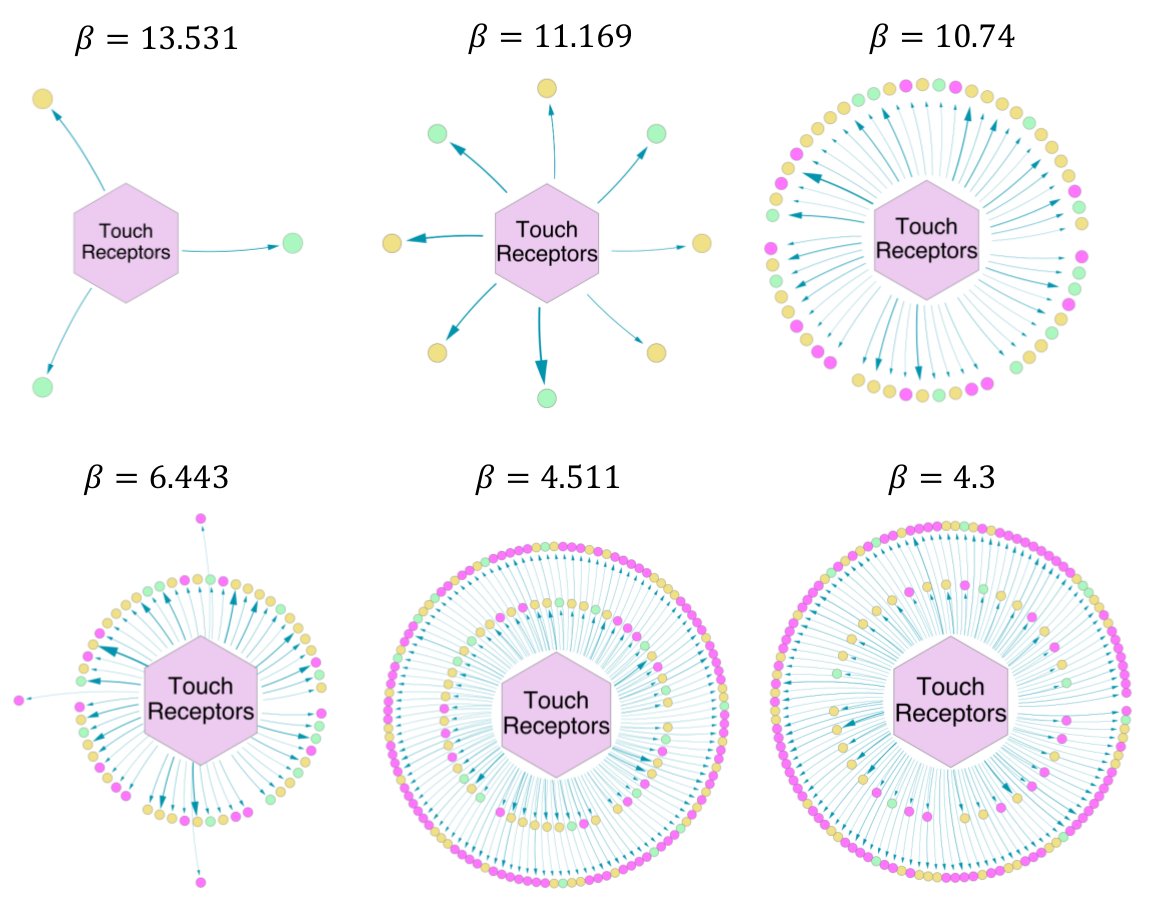
Kubo-Martin-Schwinger states of path-structured flow in directed brain synaptic networks
By E. Moutuou and H. Benali
Abstract
The brain's synaptic network, characterized by parallel connections and feedback loops, drives interaction pathways between neurons through a large system with infinitely many degrees of freedom. This system is best modeled by the graph $C^{\ast}$-algebra of the underlying directed graph, the Toeplitz-Cuntz-Krieger (TCK) algebra, which captures the diversity of path-structured flow connectivity. Equipped with the gauge action, the TCK algebra defines an algebraic quantum system, and here we demonstrate that its thermodynamic properties provide a natural framework for describing the dynamic mappings of potential flow pathways within the network. Specifically, the KMS states of this system represent the stationary distributions of a non-Markovian stochastic process with memory decay, capturing how influence propagates along exponentially weighted paths, and yield global statistical measures of neuronal interactions. Applied to the C. elegans synaptic network, our framework reveals that neurolocomotor neurons emerge as the primary hubs of incoming path-structured flow at inverse temperatures where the entropy of KMS states peaks. This finding aligns with experimental evidence of the foundational role of locomotion in C. elegans behavior, suggesting that functional centrality may arise from the topological embedding of neurons rather than solely from local physiological properties. Our results highlight the potential of algebraic quantum methods and graph algebras to uncover patterns of functional organization in complex systems and neuroscience.
Thesis defence Arsalan Rahimabadi has successfully defended his PhD thesis

Arsalan's PhD Defence
We are delighted to celebrate Arsalan’s successful PhD defence! His thesis, marks an outstanding contribution to the field of computational neuroscience and a milestone achievement in his academic journey.
We are incredibly proud of Arsalan’s hard work, creativity, and perseverance throughout the years. Congratulations, Dr. Rahimabadi — we can’t wait to see the amazing things you will accomplish next! 🎉
Publication Our paper "Brain functions emerge as thermal equilibrium states of the connectome", by Elkaioum Moutuou and Habib Benali, has now been published in Physical Review Research.
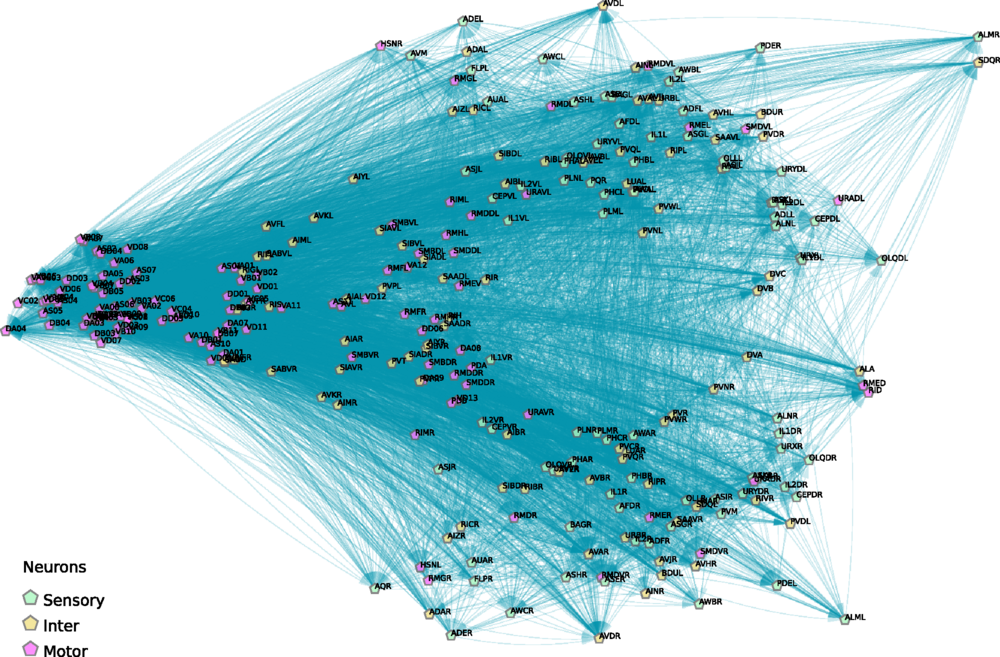
Brain functions emerge as thermal equilibrium states of the connectome
By E. Moutuou and H. Benali
Abstract
A fundamental idea in neuroscience is that cognitive functions—such as perception, learning, memory, and locomotion—are shaped and constrained by the brain's structural organization. Despite significant progress in mapping and analyzing structural connectomes, the principles linking the brain's physical architecture to its functional capabilities remain elusive. Here, we introduce an algebraic quantum model to bridge this theoretical gap, offering insights into the relationship between the connectome and emergent brain functions while connecting structural data to functional predictions. Using the well-mapped C. elegans anatomical and extrasynaptic connectomes, we demonstrate that brain functions, defined as functional networks of a neural system, emerge as thermal equilibrium states of an algebraic quantum system derived from the graph algebra of the underlying directed multigraph. Specifically, these equilibrium states, characterized by the Kubo-Martin-Schwinger formalism, reveal how individual neurons contribute to functional network formation. Our model illuminates the structure-function relationship in neural circuits through two key features: (1) a functional connectome that delineates topologically driven neuronal interactions and (2) an integration capacity index that quantifies how effectively neurons coordinate and modulate diverse information flows. Together these features provide a statistical and mechanistic account of information flow and reveal how the network topology of the connectome predicts cognition and complex behaviors.
Preprint Dr. E. Moutuou and Dr. H. Benali's preprint "KMS states of Information Flow in Directed Brain Synaptic Networks" is now live on ArXiv.
Abstract
The brain's synaptic network, characterized by parallel connections and feedback loops, drives information flow between neurons through a large system with infinitely many degrees of freedom. This system is best modeled by the graph C∗-algebra of the underlying directed graph, the Toeplitz-Cuntz-Krieger algebra, which captures the diversity of potential information pathways. Coupled with the gauge action, this graph algebra defines an {\em algebraic quantum system}, and here we demonstrate that its thermodynamic properties provide a natural framework for describing the dynamic mappings of information flow within the network. Specifically, we show that the KMS states of this system yield global statistical measures of neuronal interactions, with computational illustrations based on the {\em C. elegans} synaptic network.
Thesis defence Congratulations to Shima Panahi Moghadam Namini for successfully passing her Master's degree! ;-)

Preprint Dr. E. Moutuou and Dr. H. Benali's preprint "Brain functions emerge as thermal equilibrium states of the connectome" is now live on ArXiv.
Abstract
A fundamental paradigm in neuroscience is that cognitive functions -- such as perception, learning, memory, and locomotion -- are shaped by the brain's structural organization. However, the theoretical principles explaining how this physical architecture governs its function remain elusive. Here, we propose an algebraic quantum mechanics (AQM) framework in which the functional states of a structural connectome emerge as thermal equilibrium states of an algebraic quantum system defined on the underlying directed multigraph. These equilibrium states, derived from the Kubo-Martin-Schwinger (KMS) states formalism, capture the contribution of each neuron to the overall information flow. We apply this framework to the connectome of the nematode {\em Caenorhabditis elegans}, providing a detailed description of the KMS states, exploring their functional implications, and predicting functional networks based on anatomical connectivity. Ultimately, our approach reveals functional circuits predicted by the topology of the connectome and illuminates on the mechanisms linking structure to function.

Conference "Mostafa Sharifzadeh will be an invited speaker at the Mila Health + AI on April 22, 2024. He will be presenting his work on an innovative approach to ultrasound imaging"

Description
Phase Aberration Correction: A Deep Learning-Based Aberration-to-Aberration Approach
One of the primary sources of suboptimal image quality in ultrasound imaging is phase aberration. It is caused by spatial changes in sound speed over a heterogeneous medium, which disturbs the transmitted waves and prevents coherent summation of echo signals. Obtaining non-aberrated ground truths in real-world scenarios can be extremely challenging, if not impossible. This challenge hinders the performance of deep learning-based techniques due to the domain shift between simulated and experimental data. In this talk, I will present one of our recent studies wherein we propose a deep learning-based method that does not require ground truth to correct the phase aberration problem and, as such, can be directly trained on real data. We trained a network wherein both the input and target output are randomly aberrated radio frequency (RF) data. Moreover, we demonstrated that a conventional loss function such as mean square error is inadequate for training such a network to achieve optimal performance. Instead, we proposed an adaptive mixed loss function that employs both B-mode and RF data.
Publication The research article "Topology and spectral interconnectivities of higher-order multilayer networks" by E. Moutuou, O. Ali, and H. Benali, has just been published by Frontiers in Complex Systems.
Topology and spectral interconnectivities of higher-order multilayer networks
By E. Moutuou, O. B-K. Ali, & H. Benali
Abstract
Multilayer networks have permeated all areas of science as an abstraction for interdependent heterogeneous complex systems. However, describing such systems through a purely graph-theoretic formalism presupposes that the interactions that define the underlying infrastructures are only pairwise-based, a strong assumption likely leading to oversimplification. Most interdependent systems intrinsically involve higher-order intra- and inter-layer interactions. For instance, ecological systems involve interactions among groups within and in-between species, collaborations and citations link teams of coauthors to articles and vice versa, and interactions might exist among groups of friends from different social networks. Although higher-order interactions have been studied for monolayer systems through the language of simplicial complexes and hypergraphs, a systematic formalism incorporating them into the realm of multilayer systems is still lacking. Here, we introduce the concept of crossimplicial multicomplexes as a general formalism for modeling interdependent systems involving higher-order intra- and inter-layer connections. Subsequently, we introduce cross-homology and its spectral counterpart, the cross-Laplacian operators, to establish a rigorous mathematical framework for quantifying global and local intra- and inter-layer topological structures in such systems. Using synthetic and empirical datasets, we show that the spectra of the cross-Laplacians of a multilayer network detect different types of clusters in one layer that are controlled by hubs in another layer. We call such hubs spectral cross-hubs and define spectral persistence as a way to rank them, according to their emergence along the spectra. Our framework is broad and can especially be used to study structural and functional connectomes combining connectivities of different types and orders.
Conference "Dr Laetitia Jeancolas will present her work on "How brain perfusion changes in subjective memory loss population with amyloidosis" during the CRM scientific meeting on Vascular and Metabolic Modeling of the Brain at Large Scale."
Workshop: Vascular and Metabolic Modeling of the Brain at Large Scale
While brain function originates in neuron, its energy is supported by the vascular system. With the recent development of anatomically detailed synthetic network models of the entire cerebral circulation, it is now possible to perform detailed simulations of physiology in realistic brains of small animals and humans on the computer. Modeling microcirculatory blood flow as a biphasic suspension of red-blood-cell and plasma, blood pressure, flow and hematocrit can be simulated in whole brains on the computer. Combining Poiseuille’s hemodynamic simulations with advection/diffusion equations describing oxygen diffusion, the human brain metabolism can now be modeled in-silico, by integrating tissue oxygen consumption and differential equations describing compartments associated with neural and glial brain cells. In parallel, energy metabolism regulation in the brain and its modeling has greatly progressed over the past few decades.
This workshop will thus be focused on digital human brains, and their use to predict critical metabolic functions namely blood flow, oxygen extraction and cellular metabolism across all length scales down to the level of individual capillaries and cells. Courses and conferences will be combined with research presentations and practical workshops.
Organizers: Frédéric Lesage, Polytechnique
Location: Center de Recherche Mathématique, Université de Montréal
Dates: October 12-20
Publication The research article "Extended fractional-polynomial generalizations of diffusion and Fisher–KPP equations on directed networks" by A. Rahimabadi and H. Benali has now been published in the journal Chaos, Solitons & Fractals.
Extended fractional-polynomial generalizations of diffusion and Fisher–KPP equations on directed networks
By A. Rahimabadi, H. Benali
Abstract
In a variety of practical applications, there is a need to investigate diffusion or reaction–diffusion processes on complex structures, including brain networks, that can be modeled as weighted undirected and directed graphs. As an instance, the celebrated Fisher–Kolmogorov–Petrovsky–Piskunov (Fisher–KPP) reaction–diffusion equation is becoming increasingly popular for use in graph frameworks by substituting the standard graph Laplacian operator for the continuous one to study the progression of neurodegenerative diseases such as Alzheimer’s disease (AD). In this work, we establish existence, uniqueness, and boundedness of solutions for generalized Fisher–KPP reaction–diffusion equations on undirected and directed networks with fractional polynomial (FP) terms. This type of model has possible applications for modeling spreading of diseases within neuronal fibers whose porous structure may cause particles to diffuse anomalously. In the case of pure diffusion, convergence of solutions and stability of equilibria are also analyzed. Moreover, different families of positively invariant sets for the proposed equations are derived. Finally, we conclude by investigating nonlinear diffusion on a directed one-dimensional lattice.
Preprint Dr Elkaioum Moutuou's preprint "Topology and spectral interconnectivities of higher-order multilayer networks" is now live on ArXiv.
Abstract
Multilayer networks have permeated all the sciences as a powerful mathematical abstraction for interdependent heterogenous systems such as multimodal brain connectomes, transportation, ecological systems, and scientific collaboration. But describing such systems through a purely graph-theoretic formalism presupposes that the interactions that define the underlying infrastructures and support their functions are only pairwise-based; a strong assumption likely leading to oversimplifications. Indeed, most interdependent systems intrinsically involve higher-order intra- and inter-layer interactions. For instance, ecological systems involve interactions among groups within and in-between species, collaborations and citations link teams of coauthors to articles and vice versa, interactions might exist among groups of friends from different social networks, etc. While higher-order interactions have been studied for monolayer systems through the language of simplicial complexes and hypergraphs, a broad and systematic formalism incorporating them into the realm of multilayer systems is still lacking. Here, we introduce the concept of crossimplicial multicomplexes as a general formalism for modelling interdependent systems involving higher-order intra- and inter-layer connections. Subsequently, we introduce cross-homology and its spectral counterpart, the cross-Laplacian operators, to establish a rigorous mathematical framework for quantifying global and local intra- and inter-layer topological structures in such systems. When applied to multilayer networks, these cross-Laplacians provide powerful methods for detecting clusters in one layer that are controlled by hubs in another layer. We call such hubs spectral cross-hubs and define spectral persistence as a way to rank them according to their emergence along the cross-Laplacian spectra.
Link
Preprint Arsalan's preprint "Extended fractional-polynomial generalizations of diffusion and Fisher-KPP equations on directed networks: Modeling neurodegenerative progression" is now live.
Abstract
In a variety of practical applications, there is a need to investigate diffusion or reaction-diffusion processes on complex structures, including brain networks, that can be modeled as weighted undirected and directed graphs. As an instance, the celebrated Fisher-Kolmogorov-Petrovsky-Piskunov (Fisher-KPP) reaction-diffusion equation are becoming increasingly popular for use in graph frameworks by substituting the standard graph Laplacian operator for the continuous one to study the progression of neurodegenerative diseases such as tauopathies including Alzheimer’s disease (AD). However, due to the porous structure of neuronal fibers, the spreading of toxic species can be governed by an anomalous diffusion process rather than a normal one, and if this is the case, the standard graph Laplacian cannot adequately describe the dynamics of the spreading process. To capture such more complicated dynamics, we propose a diffusion equation with a nonlinear Laplacian operator and a generalization of the Fisher-KPP reaction-diffusion equation on undirected and directed networks using extensions of fractional polynomial (FP) functions. A complete analysis is also provided for the extended FP diffusion equation, including existence, uniqueness, and convergence of solutions, as well as stability of equilibria. Moreover, for the extended FP Fisher-KPP reaction-diffusion equation, we derive a family of positively invariant sets allowing us to establish existence, uniqueness, and boundedness of solutions. Finally, we conclude by investigating nonlinear diffusion on a directed one-dimensional lattice and then modeling tauopathy progression in the mouse brain to gain a deeper understanding of the potential applications of the proposed extended FP equations.